Plant Science Leaders - Ashish Ranjan, University of Minnesota
Aug 17, 2026
Dr.
Ashish Ranjan, molecular plant pathologist and principal investigator
of the Ranjan Lab, is advancing research on plant disease resistance to
help growers improve yields while reducing fungicide use.
Dr. Ashish Ranjan is a molecular plant pathologist and assistant
professor in the Department of Plant Pathology at the University of
Minnesota Twin Cities. As principal investigator for the Ranjan Lab, he leads research focused on how to control plant disease in ways that support yield while reducing reliance on fungicides.
By combining field screening with molecular analysis in the lab, Dr.
Ranjan’s research focuses on two crops important to Minnesota - soybean
and potato. His lab identifies naturally resistant varieties and
investigates the genetic and biochemical mechanisms behind that
resistance.
Dr. Ranjan recently sat down with Conviron to talk about his research and its larger impact on crop sustainability.
What drew you to plant pathology?
I've been here at the University of Minnesota for about four years
now. Prior to that, I was a postdoctoral researcher at the University of
Wisconsin in Madison. I've worked in plant-microbe interactions for
over 15 years, including my PhD, which was focused on rice and bacterial
diseases.
My path into plant science wasn’t a traditional one. I didn’t begin
in agriculture - I trained in biochemistry during my master’s program.
At the time, I was especially drawn to courses in plant biochemistry,
immunology, and epidemiology. These topics all genuinely excited me.
During my second year, I asked one of my professors how I could
combine my interests into one integrated path. He pointed out that while
animal and human immunology have both been studied extensively, plant
immunity remains comparatively underexplored. Most people don’t even
think of plants as having immune systems, and that gap immediately stood
out to me as an important scientific challenge.
At the same time, my personal background played a role as well. My
grandparents were farmers, and I spent many summer vacations in the
village, surrounded by crops and agriculture. Those experiences sparked
my interest early on, even if I didn’t fully recognize it at the time.
All of that eventually let me to the research questions I wanted to
ask. I decided to pursue a PhD in plant-microbe interactions, followed
by postdoctoral work, and I’ve stayed in this field ever since.
The United States is the second-largest soybean producer in the world, and Minnesota is one of the top soybean-producing states in the U.S., typically ranked fifth or sixth. Despite that scale, we lose about 10-15% of soybean production each year due to disease.
Dr. Ashish Ranjan, University of Minnesota
What does your lab at UM focus on?
Our team studies genetic disease resistance, or how plants rely on their immune systems to defend against pathogens. Some plant varieties are more naturally resistant or better at coping with disease than others, much like people. Resistant plants are often wild or less commonly grown varieties that have survived long periods under natural disease pressure.
One major focus of our work is identifying what genetic resistance exists in those plants and determining how those traits can be transferred into high-yielding elite varieties through breeding and molecular approaches. Another key part of our research is finding those resistant plants in the first place.
We conduct field experiments using disease nurseries, where we screen dozens, and sometimes more than a hundred, soybean or potato varieties against specific diseases to see which ones show resistance.
From there, we bring those resistant plants into the lab to explore the underlying molecular mechanisms, using approaches that look at RNA, DNA, and protein interactions.
What are these crops so important?
The United States is the second-largest soybean producer in the world, and Minnesota is one of the top soybean-producing states in the U.S., typically ranked fifth or sixth. Despite that scale, we lose about 10-15% of soybean production each year due to disease, which can be fungal, bacterial, nematode-related, or insect-driven. In economic terms, that translates to roughly $2 billion in losses annually.
Beyond the economic impact, soybean is extremely important nutritionally. It’s a major source of oil and protein, and many common foods such as tofu and soy milk are derived from it. On a per-gram basis, soybean protein content can exceed that of meat, without the saturated fat or cholesterol.
Increasingly, soybeans are also being used in sustainable products like bioethanol, which expands their importance beyond food.
Potatoes are similarly important. The U.S. is one of the top five global producers of potatoes, and potato is the fourth most consumed food crop worldwide. It’s energy-rich and ranks just after rice, wheat, and corn in global consumption.
Like soybean, potatoes face significant disease pressure from both fungal and bacterial pathogens, insects, and nematodes. Improving disease resistance in both crops has direct implications for yield stability, grower profitability, and long-term food security for our world.
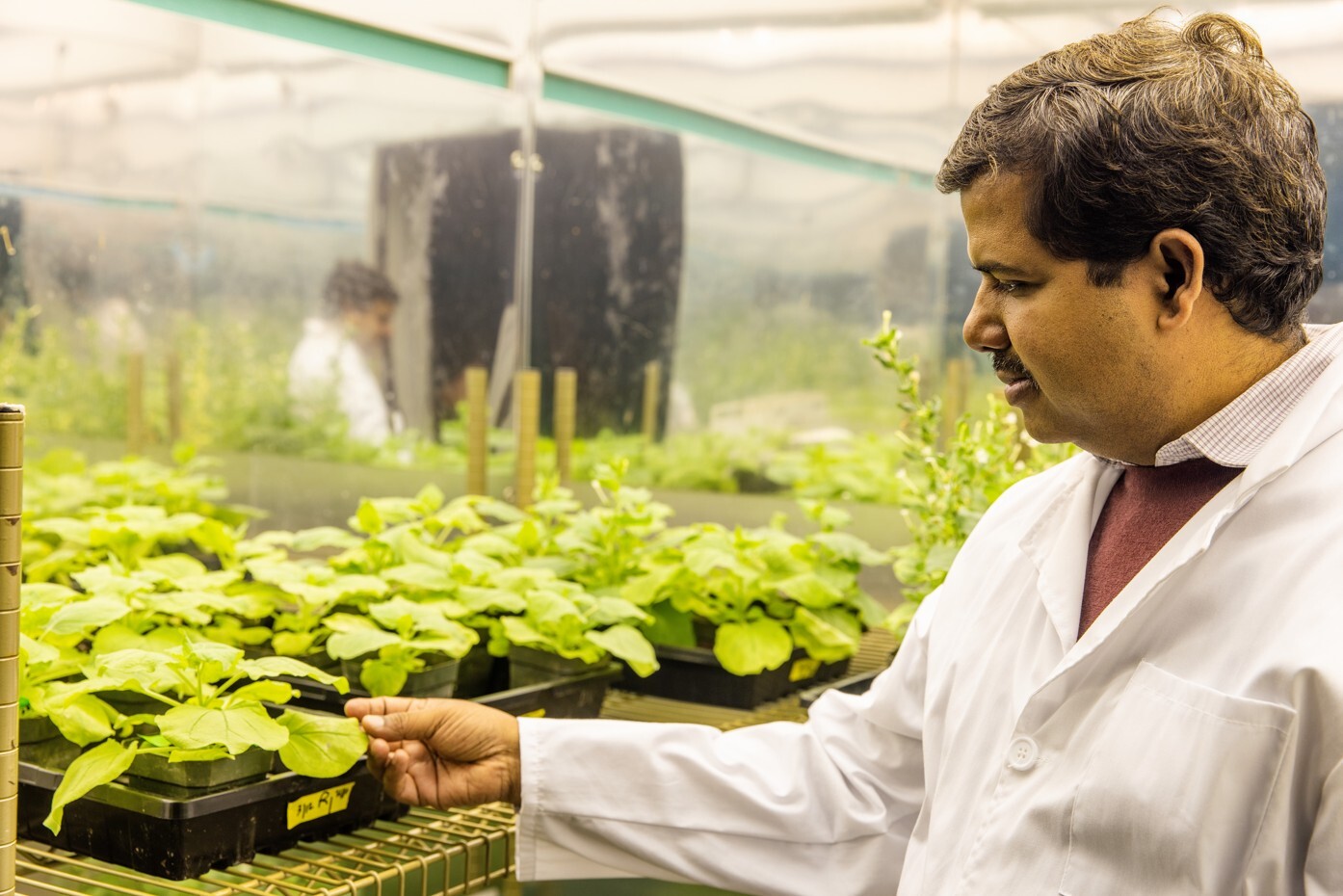
Dr. Ashish Ranjan uses controlled environment research to study plant-pathogen interactions and disease resistance in soybean and potato.
How do you integrate field and controlled environment research?
Field experiments and controlled environment research are both important for us, but they serve very different purposes. Field experiments show us what survives under real-world conditions, even with all the natural variability that comes from weather, disease pressure, and the environment.
The challenge is that when variability is high, it can be very difficult to understand exactly what caused a particular outcome. We experienced this firsthand while screening soybean varieties for white mold. Over two years, we evaluated around 100 varieties in the field.
In the first year, disease pressure was high and we saw clear differences. In the second year, we could barely find any infected plants at all, even in the same field. When conditions change that dramatically, it becomes almost impossible to repeat experiments or draw firm conclusions.
In controlled environments like growth chambers, we can inoculate plants deliberately and precisely manage environmental conditions. Our chambers have helped us generate clear, conclusive data in a much shorter time than field experiments alone. It also helps us identify which environmental parameters matter most for understanding plant–pathogen interactions, something that’s very difficult to do in the field.
Plant growth chambers are also critical for certain types of work, like gene-editing studies or pathogen challenge experiments, that aren’t appropriate to conduct in open environments. They provide a contained and controlled space where we can advance the research before moving promising results back into the field.
Dr. Ashish Ranjan discusses soybean disease resistance research with master's student and research assistant Nick Talmo (right).
What role do growth chambers play in training students?
From a training perspective, growth chambers have been extremely
valuable for giving our undergrad and graduate students hands-on
experience. They’re learning how to grow plants, inoculate them with
pathogens, and run screening experiments without the time and labor
demands of field trials. In Minnesota, where the growing season is
short, growth chambers also allow us to run experiments year-round,
which aligns much better with academic schedules. Field experiments are
the ultimate goal, but growth chambers give us the control, consistency,
and training environment we need to ask better questions and prepare
our students for success in the field.
What advice would you give students considering a career in plant science?
Whether you pursue a PhD in plant science really depends on what you
want to do. You need a solid foundation, which you can build through
undergraduate or master’s-level training, but a PhD isn’t always
necessary, especially if your goal is to help bring ideas to market.
In
industry, for example, you’re usually working on a team where the
research direction is already set. Your role is to run experiments,
generate data, and contribute to developing a solution. You can learn a
lot in that environment without having a PhD.
Dr. Ashish Ranjan mentors students and research staff in the Ranjan Lab, including Research Professional Sonal Srivastava (right), whose work focuses on identifying and characterizing Streptomyces strains from naturally infected potatoes.
If you’re someone who wants to ask your own research questions and
explore new ideas, then a PhD becomes more important. Doctoral training
gives you the freedom to design experiments, see what works and what
doesn’t, and follow different lines of thinking. That kind of
independence is hard to develop without going through the PhD process.
There isn’t one single right path. It mostly comes down to whether
you’re more excited by applying existing ideas or creating new ones, and
choosing the training that fits that.
The most important thing is motivation - understanding why you’re
doing what you’re doing and genuinely enjoying the work. Research can be
challenging, and that motivation helps you persist.
I encourage students to focus on building skills and learning how to
ask good questions and design experiments. Coursework provides technical
knowledge, but hands-on research experience is where those skills
really develop. There are many paths into plant science, and success
depends on aligning training with the impact you want to make.