
Growth Chambers for Germination
Sep 10, 2026
Overview
Seed germination and the early seedling stage are the most sensitive and vulnerable stage of plant development, directly affecting downstream growth, yield potential, and experimental reliability. Academic research demonstrates that germination success is highly dependent on tightly controlled environmental variables - especially temperature, humidity, air exchange and in some cases light.
Conviron has played a central role in the development of controlled-environment agriculture (CEA), including germination chambers and growth rooms designed to facilitate the precise regulation of environmental variables affecting seed germination. Such systems are widely utilized in academic institutions, government research organizations, seed testing laboratories, and commercial breeding programs, contributing to a substantial body of controlled environment research and development in plant science and seed biology.

Seed Germination Stages
- Imbibition: The seed takes up water and the seed coat swells and softens. It is important that seeds do not dry out after imbibition as they will die.
- Lag phase: After imbibition, the seed activates its internal physiology, cells respire, and the seed starts to make proteins by metabolizing their seed stores.
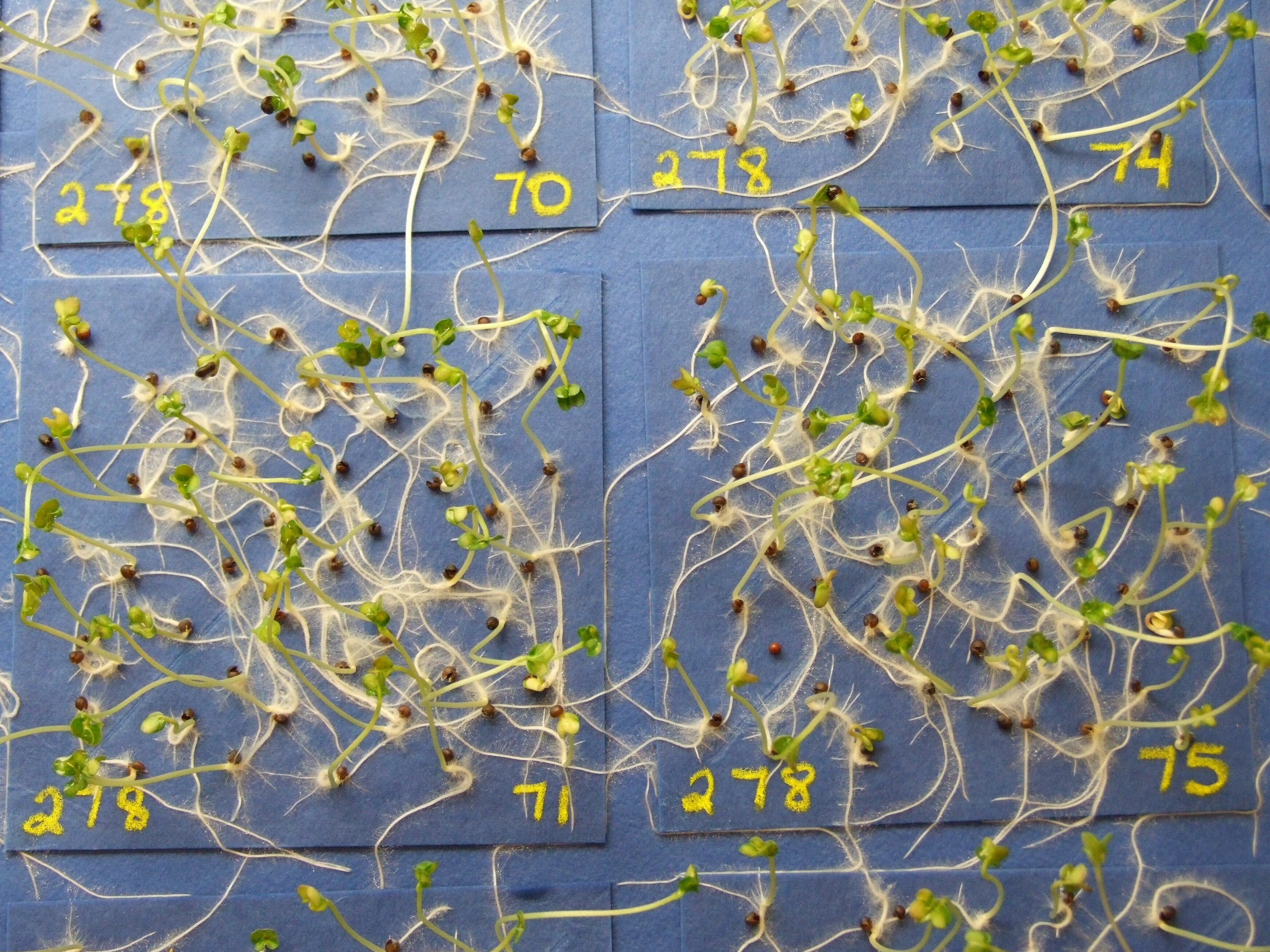
- Radicle and root emergence: The root cells start to elongate and divide, bringing the root and radicle out of the seed.
Considerations
Germination Rate: The germination rates under controlled standardized conditions should be listed on the seed packet or in the seed catalogue. Typically, they will range from 70-95%. Germination rates are maximized when exposed to specific temperatures, relative humidities and in some cases light.1
Temperature: The optimum temperature for germination is species specific and ranges from 18-29°C. The germination soil temperatures for specific crops can be found in the scientific literature, on seed packets or seed catalogues and university extension publications.
Humidity: Whether germinating seed on a bench, a generic plant growth chamber, or purpose built germination chamber it is critical to keep the relative humidity between 85-100%. This will ensure good imbibition and the subsequent physiological processes necessary for the growth into a seedling.
Light: Most seeds germinate in the dark however some plant species such as lettuce, Arabidopsis and petunia germinate more effectively when light (60-100 μmol/m2/s) is present during germination. For all plant species it is critical to supply higher light once the shoot starts to emerge to ensure a strong, non-leggy and metabolically healthy seedling. Far-red light inhibits germination and is not necessary in the spectrum for light activated germination.
Air Exchange: Adequate air exchange ensures consistent conditions across samples. The goal is to maintain sufficient air exchange to supply oxygen for seed respiration while minimizing excessive airflow that can dry the substrate and disrupt uniform germination.
The Importance of Controlled Environments in Germination
As mentioned above, seed germination considerations depend on a complex interaction of environmental parameters of temperature, humidity, light and air exchange. Even minor variability in these conditions can lead to inconsistent germination rates and unreliable experimental outcomes. Plant growth chambers and purpose built germination chambers eliminate this variability by providing precise setpoints and uniform conditions across all samples.
Conviron Germination Chambers & Rooms
Conviron growth chambers and germination rooms are engineered to provide:
- Temperature control from near-freezing to elevated temperature levels of +45°C, the lower temperatures being advantageous for pre-chilling to overcome dormancy
- High humidity control (up to ~95%)
- Programmable LED lighting (spectrum, intensity, photoperiod)
- Uniform air exchange systems and airflow for consistent atmospheric micro-climates
- Scalable solutions from single door reach-in chambers to walk-in rooms
These capabilities allow researchers to conduct highly repeatable germination experiments, reducing crop variability and improving statistical confidence.
Germination Research Using Conviron Growth Chambers
| Publication | Recent Research |
| Annals of Botany | Allocation of growth to stems underpins the response of ryegrass to elevated CO2 and temperature, 2026 |
| Agrosystems, Geosciences & Environment | Differential response of Palmer amaranth (Amaranthus palmeri) seed germination and seedling emergence under variable environmental conditions, 2026 |
| Frontiers in Plant Science | Digital morphological data can generate accurate pre-emergence herbicide dose-response curves in Chenopodium album L, 2026 |
| Genetic Resources and Crop Evolution | Diversity and genetic structure within a Mexican maize race reveal consistent biocultural processes across geographic scales, 2026 |
| Journal of Evolutionary Biology | Does genetic variation in controlled experiments predict phenology of wild plants?, 2026 |
| Environmental Microbiology | Engineering and Evaluation of Sinorhizobium meliloti Nodulation (nod) Gene Reporter Systems in Rhizobia and Non-Rhizobia, 2026 |
| Agronomy | Germination Responses of Common Chickweed (Stellaria media (L.) Vill.) to Water Potential, Salinity, and pH and Its Association with Forage Wheat Yield and Nutritive Composition, 2026 |
| HortScience | Heat and Water-deficit Stress Responses of Tomato Seedlings Grafted onto Wild-type Solanum pennellii, 2026 |
| South African Journal of Botany | Phytochemical profiling of Citrus sinensis peel essential oil and biological evaluation of its ethanol-soluble fraction: a hybrid in silico and in vitro approach for plant biostimulation and pharmacological applications, 2026 |
| Plant Signaling & Behaviour | Root-derived allelochemicals from Moringa oleifera regulate germination and early seedling growth in New Zealand pasture, native, and weed species, 2026 |
| Botany | The opposing effects of shortened days and cooling temperatures on tundra plant senescence, 2026 |
| The Plant Journal | Thermal imaging as a tool for studying circadian rhythms in roots, 2026 |
1. Regulations generally applied to and most relevant to commercial growers. Reference: Requirements Related to Germination Standards, Government of Canada, https://inspection.canada.ca/e...


White Papers
