
Part II: Lighting in Plant Growth Chambers
Nov 11, 2026
Why this topic, why now?
Lighting is one of the most critical variables in plant science research and controlled environment agriculture, directly influencing plant physiology, morphology, and productivity. As plant scientists evaluate growth chamber options, understanding the nuances of lighting is essential for designing experiments that yield reliable and reproducible results.
This second installment in our two-part series explores the practical considerations and scientific principles behind light spectrum choices for plant growth chambers, helping researchers align their choices with both experimental goals and biological needs.
This article builds on concepts introduced in Part I. For valuable background on plant light responses and lighting fundamentals, we recommend reviewing the first installment before proceeding:

Background
Light plays many roles in a plant’s life. It provides all the energy required for growth through photosynthesis. Light also carries information that directs the developmental phases such as germination, stem elongation, flowering and circadian rhythms among others through photomorphogenesis. Photosynthesis provides energy while photomorphogenesis directs the use of energy into developmental processes. The tunability of LED luminaires allows researchers to select specific spectral ratios which can enhance the desired plant research goals.
Some plant responses to common horticultural LEDs: Growth & Development
Photosynthesis provides energy for growth, photomorphogenesis drives development. They are not independent processes.
Red LEDs (600-700 nm)
Growth: Plants can grow under monochromatic red light (λmax 660 nm), but many species including lettuce, wheat, radish, pepper, cucumber, spinach and rice were less vigorous, suffered morphological aberrations, reduced stomatal function and photosynthesis compared to being grown under fluorescent or metal halide luminaires [1,2,3,4]. The addition of 10% of blue light to the monochromatic red spectrum resulted in increased plant weight and greater seed production in wheat and increased biomass of lettuce [1,4].
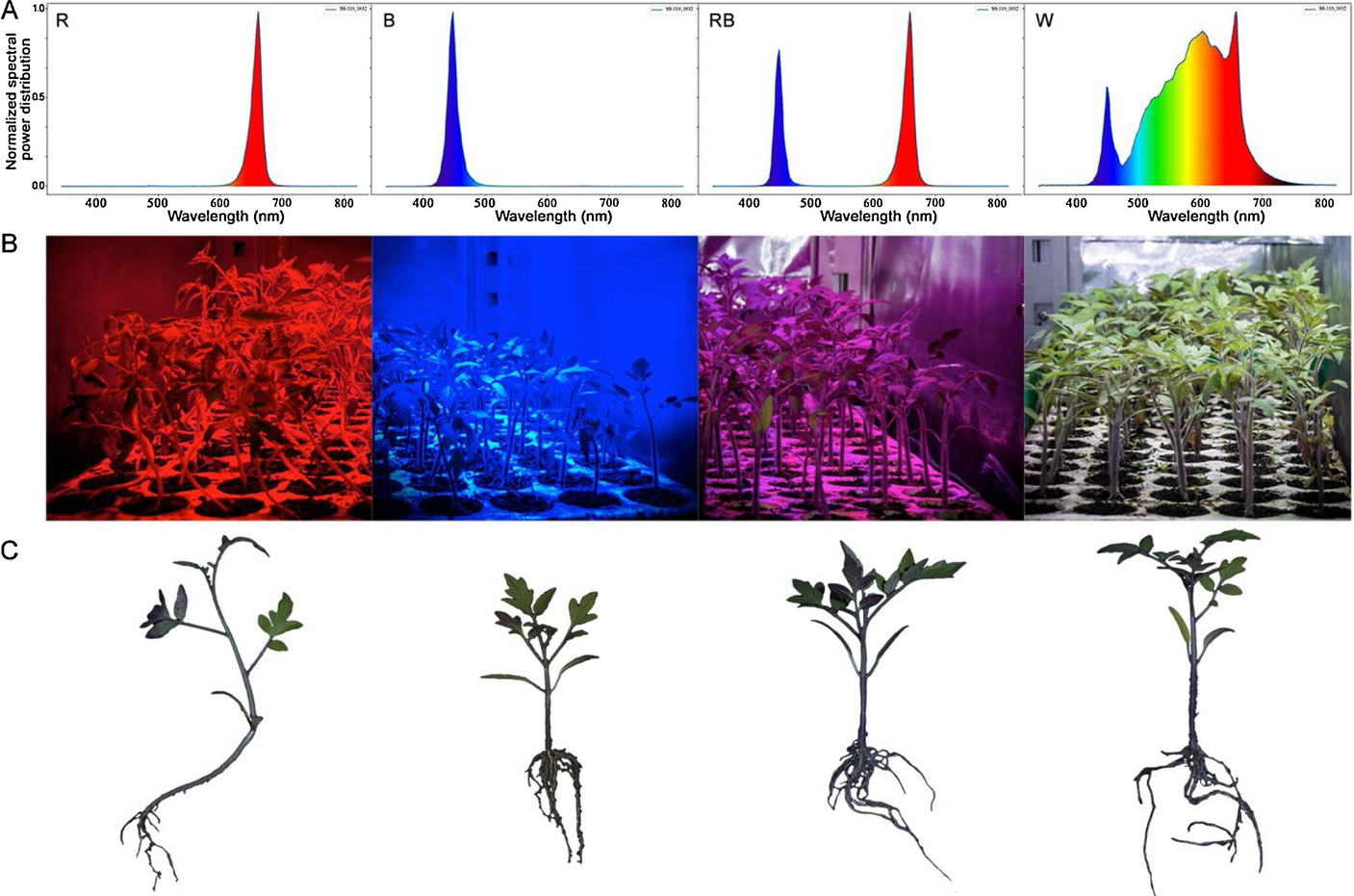
Development: The role of red light in plant development is through the activation of the well-known multifunctional family of phytochrome photoreceptors [5]. Phytochrome (PHY) controls flowering, stomatal development, photoperiodic response, leaf expansion, plant height and plant immunity among others [5]. For instance, Grand Rapid lettuce grown under monochromatic red LEDs had extended hypocotyls which was prevented by the addition of blue light [3]. Tomatoes grown under red light alone also had elongated hypocotyls, as well as cotyledon expansion, increased plant heights and reduced photosynthesis compared to combined red and blue or white LEDS [6].
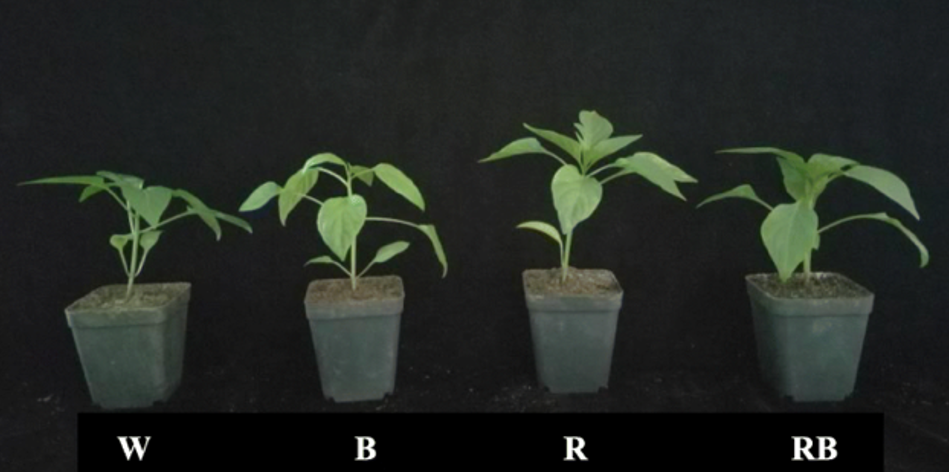
Blue LEDs (400-500 nm)
Growth: Unlike red light, photosynthesis functioned normally in cucumber grown under monochromatic blue light and dose response curves indicated that low levels of blue light could mimic high light [2]. Adding blue light to red LEDs resulted in enhanced plant growth and increased biomass in wheat, lettuce, rice and Arabidopsis indicating the importance of blue light in plant growth [8].
Development: Blue light plays a large role in plant development as it activates many families of photoreceptors including phototropins, cryptochromes and zietlupes [9]. These in turn control processes such as stomatal opening, pigment and phenolic biosynthesis, flowering, hypocotyl elongation, plant height, leaf thickness, branching, stress tolerance and circadian rhythms among others [9]. Tomato seedlings grown under blue light alone were more compact, had shorter internodes, greater biomass (due to leaf thickness) and had the highest photosynthetic rates compared to red light alone or white LEDs [6]
Green LEDs (500-600 nm)
Growth: For a long time, it was thought that green light was not necessary or used by plants however, they absorb and can use up to 80% of green photons in photosynthesis [10]. The difference is transmitted through the leaf. It has been clearly demonstrated that green light penetrates deeper into the leaf where it drives photosynthesis more efficiently than red or blue light [10]. Further investigation on supplemental green light revealed that the addition of 24% green light to a red and blue spectrum enhanced growth and leaf area in lettuce [11]. Green light is an important component in plant growth and it makes a significant contribution [12].
Development: While no unique green photoreceptor has been identified, green light plays a role in plant development by reversing blue and red light induced photomorphogenic responses [13]. It acts as a brake. Although crop specific, green light can improve water use efficiency in lettuce through the control of stomatal conductance [14]. Green light impacts stomatal opening, anthocyanin accumulation. flowering, hypocotyl elongation and the shade avoidance response among others [9].

Far-red LEDs (700-800 nm)
Growth: The effects of far-red light in controlled plant research are still being enthusiastically discussed today. The first non-visible LED to be developed was infrared (>700 nm) in 1961 for use in electronic devices [15]. Although this waveband is not implicated in photosynthesis per se there is a new metric being proposed known as ePAR (extended Photosynthetic Active Radiation) which includes both PAR and far red [16]. Far-red in the spectrum enhances linear electron transport which in turn improves photosynthetic efficiency [17].
Development: Far-red light is a powerful signal for plants. Far-red light reverses the red activation of PHY thereby making PHY a reversible photo-controllable switch for plant development [18]. Far-red light controls stomatal development, flowering, photoperiodic responses, hypocotyl elongation, leaf expansion, shade avoidance syndrome, plant height, plant immunity, plant defense among others [18,19]. Far-red light increases leaf area and contributes to photosynthesis by increasing the probably of photon capture.

White LEDs (400-750 nm)
In 1996, the first white LEDs were commercially available (Cho et al 2017). Shortly after the blue LED was invented it was discovered that by applying phosphor coatings to the lenses created white light by down-shifting and expanding spectrum to include green, yellow, red and in some cases far-red. White LEDs are usually described by color temperature which range from warm white (2500-3500 K), neutral white (3500–4500 K), cool white (4500–5500 K), and daylight (5500–7500 K) [20]. The higher the color temperature, the bluer the spectrum.
The broad spectrum of white LEDs can drive both photosynthesis and plant development. Cool white LEDs at either low or high intensities are the light of choice because of their higher percentage of blue, their higher efficiency and good plant productivity compared to neutral or warm white LEDs [21]. Cool white LEDS can have approximately 26% blue, 49% green, 22% red and 3% far-red light while warm white LEDS can be made up of about 7% blue, 28% green, 53 % red and 11% far-red [22]. White light is complicated; many commercially available horticultural lights mix warm and cool white LEDs or mix white LEDs with blue or red LEDs. Each combination can have different physiological and morphological effects on plants.
 | Figure 5. Red lettuce cultivars Rouxai (A), Red Butter (B) and Red Oakleaf (C) grown under a red, blue and white spectrum (RBW) and a white spectrum. The white spectrum produced good growth but significantly lower anthocyanins which contribute to color and nutrient density compared to white light alone. (Photo courtesy of T. Pocock). |
Conclusion
There is no single "best" light spectrum for every plant, growth chamber, or research objective. While plants can grow under relatively simple lighting conditions, decades of plant science research have demonstrated that spectral composition influences far more than photosynthetic rate alone. Light quality can affect plant morphology, biomass accumulation, leaf expansion, flowering, pigmentation, photomorphogenic responses, and ultimately experimental outcomes.
As lighting technologies continue to evolve, researchers have greater flexibility than ever to tailor spectral conditions to specific crops and research goals. However, the ability to adjust spectrum is only valuable when it is grounded in a clear understanding of plant physiology and the biological questions being investigated.
Rather than pursuing the newest or most complex lighting solution, the choice in lighting solution should prioritize lighting conditions that support reproducible results, accurately represent production environments where appropriate, and align with the objectives of the study. By understanding how different wavelengths influence plant responses and how those wavelengths interact within a canopy, researchers can make more informed decisions when configuring growth chamber environments. In doing so, they can create conditions that not only support healthy plant growth but also improve the reliability, relevance, and scientific value of their research.
This concludes our two-part series on lighting in plant growth chambers. Together, these articles provide a foundation for understanding both the fundamental principles of plant lighting and the practical considerations involved in selecting spectra for controlled environment research.
References
[1] G.D. Goins, N.C. Yorio, M.M. Sanwo, C.S. Brown. (1997) Photomorphogenesis, photosynthesis, and seed yield of wheat plants grown under red light-emitting diodes (LEDs) with and without supplemental blue lighting. Journal of Experimental Botany. 48(7): 1407–1413.
[2] S. W. Hogewoning, G. Trouwborst, H. Maljaars, H. Poorter, W. van Ieperen, J. Harbinson. (2010) Blue light dose–responses of leaf photosynthesis, morphology, and chemical composition of Cucumis sativus grown under different combinations of red and blue light. Journal of Experimental Botany. 61(11): 3107–3117.
[3] M.E. Hoenecke, R.J. Bula, T.W. Tibbitts. (1992) Importance of 'blue' photon levels for lettuce seedlings grown under red-light-emitting diodes. HortScience. May;27(5):427-430.
[4] N.C. Yorio, G.D. Goins, H.R. Kagie, R.M. Wheeler, J.C. Sager. (2001) Improving spinach, radish, and lettuce growth under red light-emitting diodes (LEDs) with blue light supplementation. HortScience. 36(2):380-383.
[5] H. Smith and Whitelam, G.C. (1997). The shade avoidance syndrome: multiple responses mediated by multiple phytochromes. Plant, Cell & Environment. 20: 840-844.
[6] L. G. Izzo, B. H. Mele, L. Vitale, E. Vitale, C. Arena. (2020) The role of monochromatic red and blue light in tomato early photomorphogenesis and photosynthetic traits. Environmental and Experimental Botany. 179: 104195.
[7] Y. Li, G. Xin, C. Liu et al. (2020) Effects of red and blue light on leaf anatomy, CO2 assimilation and the photosynthetic electron transport capacity of sweet pepper (Capsicum annuum L.) seedlings. BMC Plant Biology. 20, 318.
[8] K. Ohashi-Kaneko, R. Matsuda, E. Goto, K. Fujiwara and K. Kurata. (2006) Growth of rice plants under red light with or without supplemental blue light. Soil Science and Plant Nutrition. 52(4): 444–452.
[9] T. Pocock. (2015) Light-emitting diodes and the Modulation of specialty crops: Light sensing and signaling networks in plants. HortScience. 50(9): 1281-1284.
[10] van Iersel MW and Liu J. (2021) Photosynthetic physiology of blue, green, and red light: Light intensity effects and underlying mechanisms.Front. Plant Sci.
[11] H.-H. Kim, G. Goins, R. Wheeler and J. Sager. (2005). Green-light supplementation for enhanced lettuce growth under Red- and Blue-light-emitting diodes. HortScience. 39. 1617-22.
[12] H.L. Smith, L. McAusland and E.H. Murchie. (2017) Don't ignore the green light: exploring diverse roles in plant processes. J Exp Bot. 68(9):2099-2110.
[13.] T. Zhang and K.M. Folta. (2012) Green light signaling and adaptive response. Plant Signal Behav. 7(1):75-8.
[14] Y. Chen, Z. Bian, L.F.M. Marcellis, E. Heuvelink, Q. Yang and E. Kaiser. (2024). Green light is similarly effective in promoting plant biomass as red/blue light: a meta-analysis. Journal of Experimental Botany. 75(18): 5655-5666.
[15] S. Mane. (2023) The evolution of light Emitting diodes: From theory to practical applications. International Journal of All Research Education and Scientific Methods. 11(7): 1710-1716.
[16] S. Zhen and B. Bugbee. (2020) Substituting Far-Red for Traditionally Defined Photosynthetic Photons Results in Equal Canopy Quantum Yield for CO2 Fixation and Increased Photon Capture During Long-Term Studies: Implications for Re-Defining PAR. Frontiers in Plant Science. 11-2020.
[17] M. W. van Iersel. (2017) Optimizing LED lighting in controlled environment agriculture. In: Light Emitting Diodes for Agriculture. Ed: S.D. Gupta. Sringer Nature. Pp: 59-80.
[18] H. Smith and G.C. Whitelam. (1997) The shade avoidance syndrome: Multiple responses mediated by multiple phytochromes. Plant Cell Environ. 20:840–844.
[19] K.A. Franklin and P.H. Quail. (2010) Phytochrome functions in Arabidopsis development. J. Photochem. Photobiol. 61:11–24.
[20] P.Kusuma, P.M. Pattison and B. Bugbee. (2020) From physics to fixtures to food: current and potential LED efficacy. Hortic. Res. 7:56.
[21] K.R. Cope and B. Bugbee. (2013) Spectral effects of three Types of white light-emitting diodes on plant Growth and development: Absolute versus relative Amounts of blue light. SpaceDynamics Laboratory Publications. Paper 32.
[22] E. Runkle. White LEDs for plant applications.
