
Plant Growth Chambers for Arabidopsis thaliana
May 8, 2026
Plant Biology’s Model Organism
Although Arabidopsis thaliana has been used in plant science research since the early 1900s, it was only adopted as the universal model organism for plant science research in the 1980s1. Since then, over 2000 known accessions have been collected from around the globe and 1,135 of these natural inbred accessions have been completely sequenced2. The three accessions Columbia (Col), Landsberg erecta (Ler) and Wassilewskija (Ws) are considered the standard genotypes and are most commonly grown3. For physiological and biochemical research Col is generally regarded to be the reference genotype.

Arabidopsis was the first plant genome to be completely sequenced, and its small genome, fast growth cycle and high rate of self-fertilization has allowed researchers to gain deeper understanding of plant processes and resilience to climate change 4,5. Although it is not technically an economically valuable plant, over 70% of agricultural advancements can be traced back to fundamental Arabidopsis research6.
Growing Arabidopsis
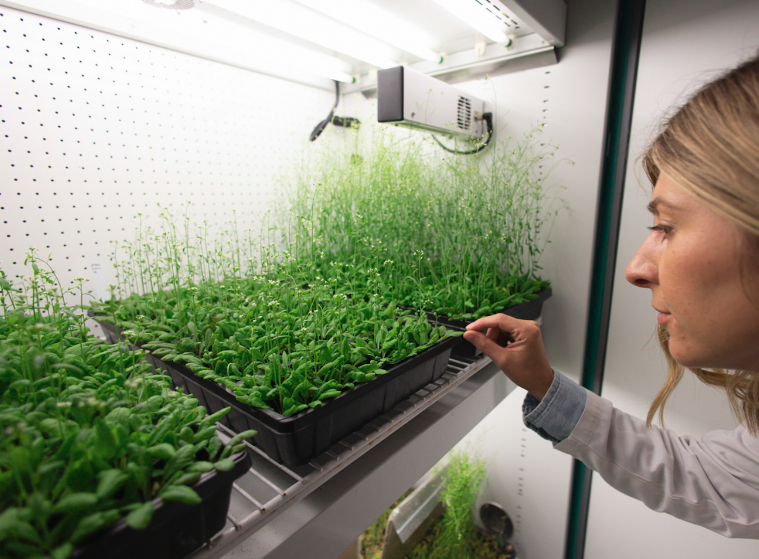
Arabidopsis grows well in controlled environmental growth chambers. They are small plants with short generation times and can produce a large number of seeds. Depending on the accession and/or the desired environment, seeds germinate within 3-5 days under continuous light, 23°C, and adequate fertigation. Flowering begins within 4-5 weeks and seeds can be harvested at 8-10 weeks after sowing7. Healthy plants and high-quality seeds are obtained when light, temperature, and watering are carefully controlled and in balance.
Light Requirements
Arabidopsis is a low light plant, with optimal intensities ranging from 120-150 mmol/m2/s at temperatures of 22-23°C. High light can induce death or stress on seedlings but is tolerated by older plants. Tolerance to high light is accession dependent, for instance light response curves indicated that Col-08 performs better at higher light than WS-2. The saturation PPFDs were 300 mmol/m2/s and approximately 180 mmol/m2/s, respectively8. Arabidopsis is a facultative long-day plant that flowers quickly under either continuous light or photoperiods >12h. The recommended photoperiod is either continuous light or 16h light/ 8h dark periods9. LED lights are used now, and the spectrum may have to be adjusted or selected for the optimal growth of individual accessions and outcomes. It has been shown that Arabidopsis can grow under polychromatic LED lights however flowering was delayed by 4 days compared to fluorescent lights due to the absence of far-red10. Similarly to other research crops, Arabidopsis requires broad spectrum light which includes blue, green and red regions and for early flowering far-red light is required.
Temperature Requirements
Arabidopsis can grow at temperatures between 16-25°C. Temperatures above 28°C can be damaging during the germination and early rosette development stages but can be tolerated by mature plants. At lower temperatures growth is slow, the vegetative stage is prolonged and flowering is delayed. High temperatures will result in reduced number of leaves, flowers and seeds11. Different accessions respond differently to temperature. For instance, it has been found that at 37°C Ler was a more thermotolerant phenotype compared to Col-0 with respect to cell division and pollen development12.
Temperature requirements vary according to the accession or ecotype. Some Arabidopsis accessions require vernalization, a cold period to initiate flowering, while some accessions including popular lines, require stratification, a cold period to break seed dormancy and induce germination. For stratification, a cold treatment at 4°C for 3 days can increase the germination rate and synchronicity. Extended cold periods of up to 7 days is required for freshly harvested seeds and for certain accessions13.
Water Relations
Water relations affect the growth of Arabidopsis. Plants can tolerate relative humidities as low as 20-30% with the optimal range being between 50-60% but during silique maturation 50% is recommended14. The seedlings are small, especially when grown in soil, are sensitive to over watering. Proper drainage is important, and watering frequency is generally once or twice a week however this needs to be increased during silique filling15.
CO2 Requirement
Arabidopsis grows well under ambient CO2 concentrations (~380-400 ppm). Increasing CO2 from 400 ppm to 800 ppm during growth of Col-0 resulted in increased biomass if the nutrition was adequate for the subsequent increased photosynthesis and growth16,17. If CO2 levels are too low, the plant will be smaller and flowering is delayed18. It has been shown that Col-0 grown under 800 ppm CO2 had greater shoot and root biomass, higher photosynthetic rates, lower transpiration rates but had lower leaf nitrogen concentration and a modified C/N ratio19.
Many faces of Arabidopsis thaliana
There are many geographic phenotypes, accessions and mutants to choose from for specific plant science, ecological and environmental research topics. Although there is a general growth protocol to achieve healthy plant growth the environment may need to be adjusted for different accessions. Further, some accessions may need vernalization to flower or stratification to germinate:

Common Research Topics
Being the primary model organism in plant biology, Arabidopsis thaliana is used to understand fundamental processes that govern plant growth, development, physiology, and environmental responses. Its simple morphology, and extensive genetic resources make it ideal for mechanistic plant science research. This knowledge directly informs crop improvement, sustainability, and climate‑resilient agriculture, and a variety of other research areas such as:
- Light, photoperiod, and flowering time
- CO2 and gas exchange physiology
- Gene function and phenotyping
- Plant hormones and growth regulation
- Plant development and architecture

Recommended Plant Growth Chambers
Controlled‑environment growth chambers are a cornerstone of Arabidopsis research. Reach-in plant growth chambers are the most common choice, offering precise environmental control within a compact footprint. Walk-in or multi-chamber facilities are also well suited when experiments require replication across multiple environmental conditions. Minimal vertical space is sufficient making multi-tier plant growth chambers ideally suited in most cases. Advanced growth chambers equipped with independently programmable LED lighting, cold and heat stress capability, and precise humidity control further support a wide range of physiological, developmental, and stress response studies. Typical growth chamber and room alternatives include multi-tier variants of the following models:
Select Research
A select cross section of recent Arabidopsis related research using Conviron chambers and rooms is outlined below:
Publication | Recent Research |
BMC Plant Biology | The Arabidopsis UMAMIT30 transporter contributes to amino acid root exudation, 2026 |
Plant Cell Reports | |
Journal of Experimental Botany | |
Plant Physiology and Biochemistry | |
Plant Communication | |
The Plant Journal | |
Plant & Cell Physiology | |
The Plant Cell | |
Plant & Cell Physiology | |
The Plant Journal | |
Molecular Genetics & Genomics | |
Plant Direct | |
Nucleic Acids Research | |
Cell Reports | |
Theoretical & Applied Genetics | |
Plant Biotechnology |
Endnotes
1. Koonneef, M. and D. Meinke. (2010). The development of Arabidopsis as a model plant. The Plant Journal. 61:909-921.
2. 1001 Genomes Project.
3. Koonneef, M. and D. Meinke. (2010). The development of Arabidopsis as a model plant. The Plant Journal. 61:909-921.
4. Koonneef, M. and D. Meinke. (2010). The development of Arabidopsis as a model plant. The Plant Journal. 61:909-921.
5. The Arabidopsis Genome Initiative. (2000) Analysis of the genome sequence of the flowering plant Arabidopsis thaliana. Nature: 408.
6. Friesner, J.D. et. al. (2025) In defense of funding foundational plant science. The Plant Cell. 37: koaf106.
7. Rivero, L. et. al. (2014) Handling Arabidopsis plants: Growth, preservation of seeds, transformation, and genetic crosses. In: Sanchez-Serrano, J., Salinas, J. (eds) Arabidopsis Protocols. Methods in Molecular Biology, vol 1062. Humana Press, Totowa, NJ.
8. Yin, L. et. al. (2012) Photosystem II function and dynamics in three widely used Arabidopsis thaliana accessions. Plos One. 7(9): e46206.
9. Rivero, L. et. al. (2014) Handling Arabidopsis plants: Growth, preservation of seeds, transformation, and genetic crosses. In: Sanchez-Serrano, J., Salinas, J. (eds) Arabidopsis Protocols. Methods in Molecular Biology, vol 1062. Humana Press, Totowa, NJ.
10. Janda, M. et. al.(2015) Growth and stress responses in Arabidopsis thaliana, Nicotiana benthamiana, Glycine max, Solanum tuberosum, and Brassica napus cultivated under polychromatic LEDs. Plant Methods.11:31.
11. Rivero, L. et. al. (2014) Handling Arabidopsis plants: Growth, preservation of seeds, transformation, and genetic crosses. In: Sanchez-Serrano, J., Salinas, J. (eds) Arabidopsis Protocols. Methods in Molecular Biology, vol 1062. Humana Press, Totowa, NJ
12. De Jaeger-Braet. (2025) Arabidopsis accessions and their difference in heat tolerance during meiosis. Plant Physiology. 197(2): kiaf055.
13. Rivero, L. et. al. (2014) Handling Arabidopsis plants: Growth, preservation of seeds, transformation, and genetic crosses. In: Sanchez-Serrano, J., Salinas, J. (eds) Arabidopsis Protocols. Methods in Molecular Biology, vol 1062. Humana Press, Totowa, NJ.
14. Rivero, L. et. al. (2014) Handling Arabidopsis plants: Growth, preservation of seeds, transformation, and genetic crosses. In: Sanchez-Serrano, J., Salinas, J. (eds) Arabidopsis Protocols. Methods in Molecular Biology, vol 1062. Humana Press, Totowa, NJ.
15. Rivero, L. et. al. (2014) Handling Arabidopsis plants: Growth, preservation of seeds, transformation, and genetic crosses. In: Sanchez-Serrano, J., Salinas, J. (eds) Arabidopsis Protocols. Methods in Molecular Biology, vol 1062. Humana Press, Totowa, NJ.
16. Jauregui et al. (2015) Root and shoot performance of Arabidopsis thaliana exposed to elevated CO2: A physiologic, metabolic and transcriptomic response. Journal of Plant Physiology. 15:189:65-76. doi: 10.1016/j.jplph.2015.09.012.
17. Li, Y. et al. (2014) Was low CO2 a driving force of C4 evolution: Arabidopsis responses to long-term low CO2 stress. Journal of Experimental Botany. 65: 3657-3667.
18. Jauregui, I. et. al. (2016) Root-shoot interactions explain the reduction of leaf moneral content in Arabidopsis plants grown under elevated [CO2] conditions. Physiologia Plantarum. 158(1): 65-79.
19. Jauregui, I. et. al. (2016) Root-shoot interactions explain the reduction of leaf moneral content in Arabidopsis plants grown under elevated [CO2] conditions. Physiologia Plantarum. 158(1): 65-79


White Papers
